

Why 'Reach' Is Crap
Nobody remembers your reach, they remember how you made them feel. Lessons from the World Cup half-time show

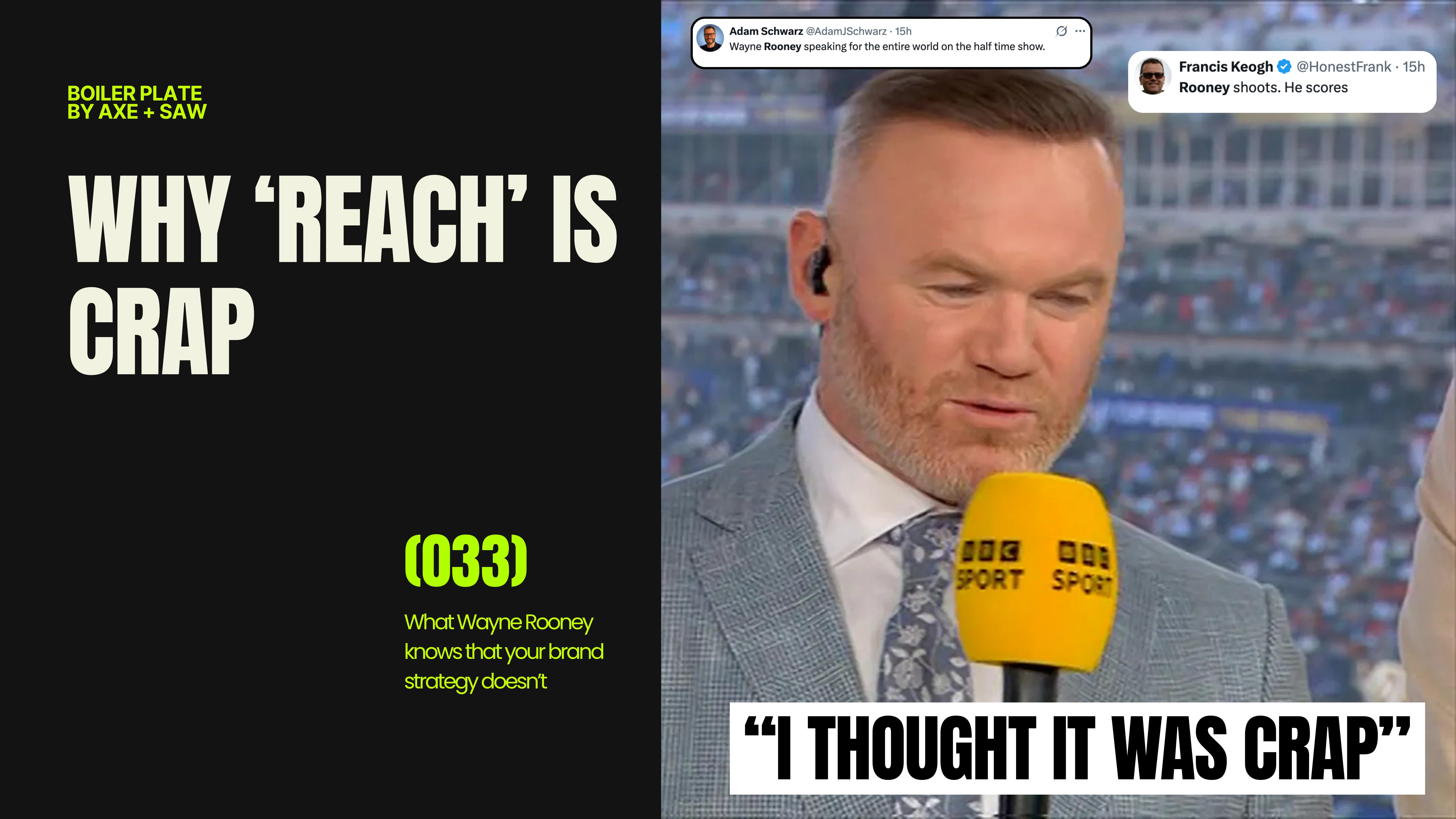
This year’s hosts wanted to leave their mark on the World Cup. And in true US style: bells, whistles, budget, glitz… A Super Bowl-style half-time show, dropped into the middle of football’s biggest night. Something, we’re pretty sure, nobody actually asked for.
But that’s not really the story. The story is what it revealed.
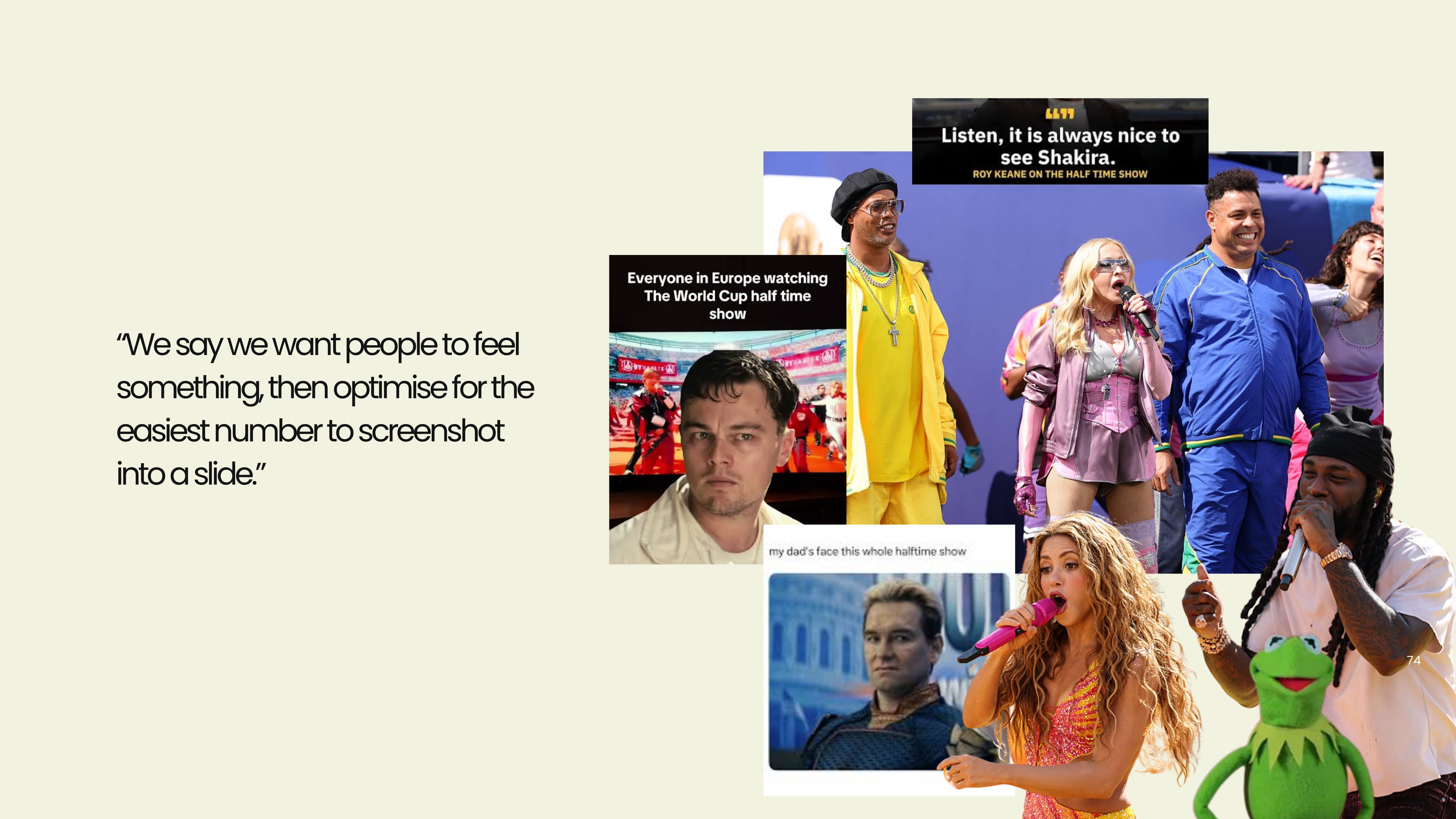
It was a masterclass in not reading the room albeit clearly built for the global stage, not the football fan actually in the game who has continued to support no matter the weather, country or performance. And the internet agreed. Justin Bieber’s ballad, mid-game, became the moment everyone was talking about from a Gen Z audience perspective but as for the rest. It wasn’t popping up in our what’s app group chats for the reason anyone hoped.
“It was crap,” said Wayne Rooney, and somehow that three-word review did more work than the entire production budget. Thousands took to TikTok, Instagram, X, asking what they’d just watched. Honestly? We’d have been more surprised if it landed.
So why did it fall so flat?
Madonna. Bieber. Shakira. Some of the biggest names on the planet, on football’s biggest stage. A line-up built to dominate conversation - a moment engineered for reach.
But nobody remembers your reach. They remember how it made them feel.
Football is the people’s game. Its power was never manufactured. It was built slowly, over decades, through community, ritual, tension, identity, belonging. Through songs passed down generations, shirts worn until they fall apart, players who become symbols of entire eras and postcodes. The stakes were already intimate. Already enormous. Spectacle didn’t add to that - it sat on top of it, unasked for.
This is the feeling brands spend millions trying to manufacture. And it’s not just a FIFA problem.
The industry is chasing its own tail
Authenticity, community, fandom…
Every deck says it, every pitch leads with it. And yet strategy is still being built on follower counts, impressions, engagement rate. We say we want people to feel something, then optimise for the easiest number to screenshot into a slide.
A few months back, Adam Mosseri addressed Instagram’s “Great Purge” of fake and inactive accounts, and the follower-count-is-dead conversation did its predictable lap of the industry again. We’d be a little concerned if that’s still landing as news for anyone reading this.
Followers have been losing value since the day we left chronological feeds for the algorithm. The blue tick, once a marker of status, now just verifies you pay £8 a month. Likes, once a signal of real approval, got bought by the thousand. Comments, the last place we went looking for proof of real community, got filled with bot fire emojis and “love this 🔥🔥.” Every signal we’ve trusted has had a shelf life of about eighteen months before the market learned to fake it.
Here’s the actual question worth sitting with: have we gotten so reliant on the metric that we forgot what it was ever standing in for?
Trace the path properly:
Followers were the first signal…big number, big audience, big influence. Simple, until the feed stopped being chronological and reach stopped being guaranteed.
So we moved to likes… until likes became a line item you could buy.
So we went digging in the comments for something unfakeable…until the bots got there too.
Every time, the metric lost its value about as fast as it gained it. Because none of them were ever the actual thing. They were placeholders, proxies for trust, for community, for do people actually believe this. And that question is hard to answer and impossible to put in a slide. So we kept reaching for the nearest number that gestured vaguely in its direction.
So where does real influence live now?
It’s migrated - again! Away from anything that can be bought in bulk, and further down: into the group chat. The Reddit thread three replies deep. The “honestly, just try it” from a mate. The voice note. The recommendation across a dinner table with no tracking link attached.
Because what we’re actually chasing was never on a dashboard. It’s trust. It’s a feeling. It’s the sense that something is worth telling someone else about.
And somewhere in the chase, plenty of brands forgot that. Reach became the brief. Events got built for shareability. Partnerships got sized by follower count. Community and fandom got flattened into an engagement report. Budget followed the number, not the feeling.
We’re not in the business of accumulating metrics. We’re in the business of leaving something behind.
It should always be about the feeling, or the shift in perception - we should build experiences that become a shared memory that earned the right to be talked about.
Metrics are evidence, not the verdict
This isn’t an argument against measurement, but a reminder to look beyond the metrics.
They’re brilliant servants and terrible masters. The moment the number becomes the entire definition of the work, we start optimising for the measurable and quietly losing the memorable.
The numbers tell you what happened, but they were never going to tell you the whole story of what it meant.
If you want your work to stand the test of time, shape it around the impact you’re trying to make, not the number used to prove it happened. What that actually looks and feels like in practice for the people you’re speaking to.
Culture won’t ever live on a dashboard
The industry will keep building better dashboards. The channels will keep shifting. Whatever we’re measuring today gets gamed by next year, and we’ll go looking for the signal somewhere else. That’s just the nature of it and that’s fine.
What’s never changed is the actual goal: legacy, community, trust. Built through work that gets under people’s skin - work that makes them see something differently, gives language to something they already felt, or earns a real place in their lives.
Football didn’t need a half-time show to make anyone feel something. The songs were already in the stands. The stories were already being passed down. The stakes were already there.
That’s the whole lesson.
Don’t add spectacle because it inflates the number of people you can claim to have reached. Build something worth remembering.
Nobody remembers your reach. They remember how you made them feel.
Decorating a thing with bells and whistles doesn't always help to produce a feeling. Can't agree more.